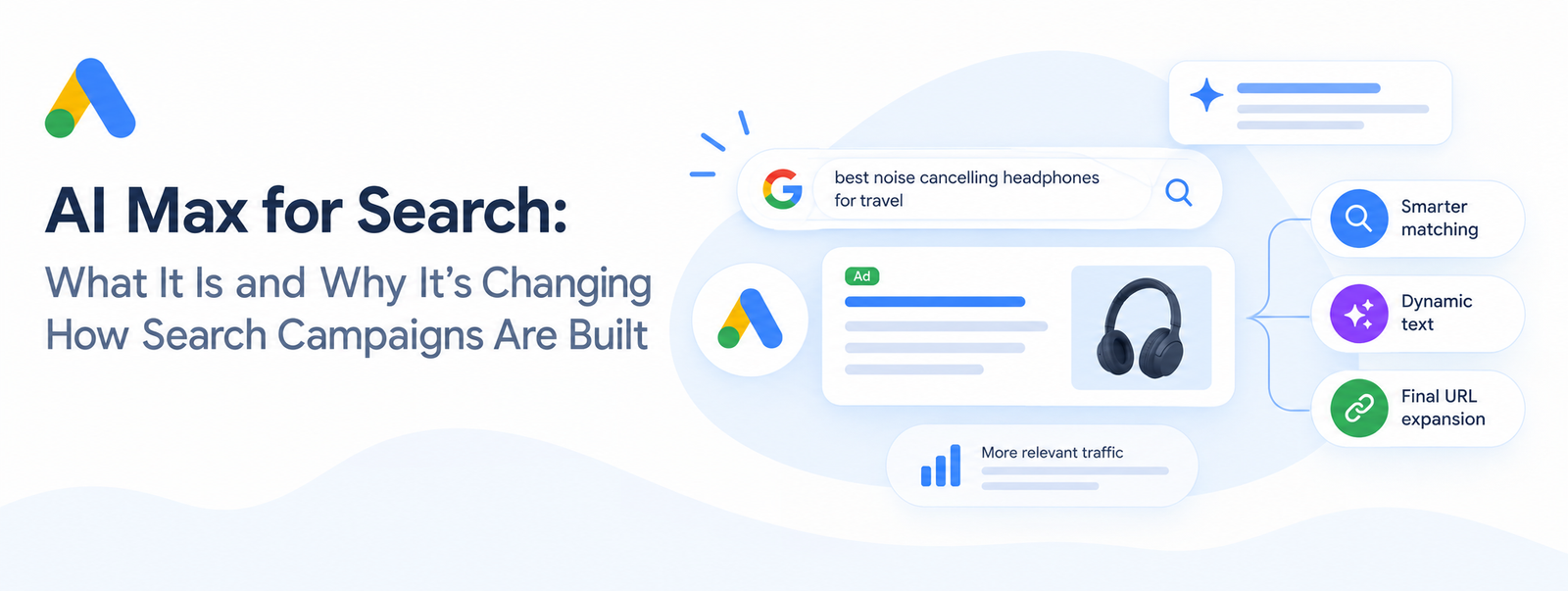
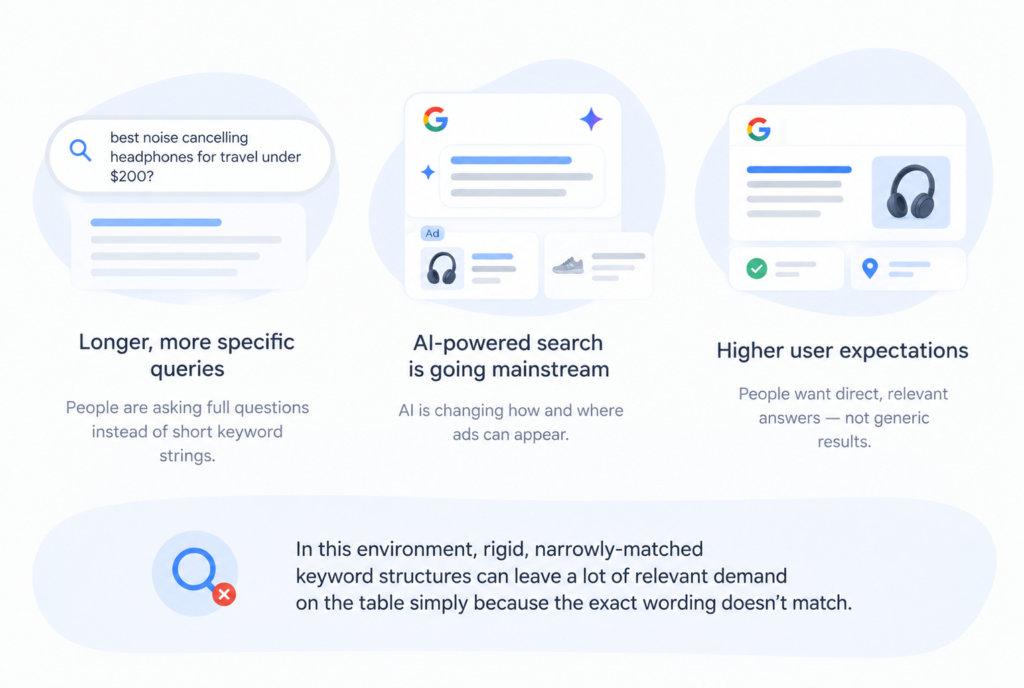
Google Search has changed dramatically over the past couple of years. People are typing longer, more conversational queries, engaging with AI-powered answers, and expecting search to feel less like a list of blue links and more like a conversation. Naturally, the advertising layer on top of Search had to evolve too — and that’s where AI Max for Search campaigns comes in.
What Is AI Max?
AI Max is essentially a bundle of AI-driven features you can turn on for your existing Search campaigns to help them keep up with how people search today. Instead of adding a new campaign type, it upgrades the campaigns you already have, combining three core capabilities:
Search term matching – a more flexible, intent-based way of connecting user queries to your keywords, going beyond rigid match-type rules.
Text customization – dynamically adjusting headlines and descriptions based on what the person actually searched for.
Final URL expansion – sending users to the most relevant page on your site for their specific query, even if it’s not the exact URL you originally set.
Together, these features are designed to capture more relevant traffic without requiring you to constantly expand your keyword lists manually.
Why This Matters Now?
From Match Types to Signal-Based Targeting
Traditionally, advertisers relied on exact, phrase, and broad match to control which searches triggered their ads — often running all three in parallel to «cover all the bases.» AI Max shifts the logic: rather than segmenting traffic into rigid buckets, it treats your existing keywords as strong intent signals and expands matching around them using machine learning, while still respecting the safeguards you set.
The practical implication is that many advertisers no longer need separate campaigns per match type. A single, well-optimized campaign using Smart Bidding can capture a broader set of relevant queries than three parallel, siloed ones.
Keeping Control: Safeguards Still Matter
Giving the algorithm more flexibility doesn’t mean giving up control. There are still several levers advertisers should actively manage:
Negative keywords to filter out clearly irrelevant traffic.
Location targeting at the ad group level to keep geographic relevance tight.
Brand inclusion/exclusion settings to control whether your ads compete on branded or competitor terms.
URL exclusions to prevent traffic from being sent to pages you don’t want promoted (like a careers page or an out-of-stock category).
Text guidelines to keep AI-generated headlines and descriptions aligned with your brand voice.
Used well, these controls let you benefit from expanded reach without losing the guardrails that protect your budget and brand.
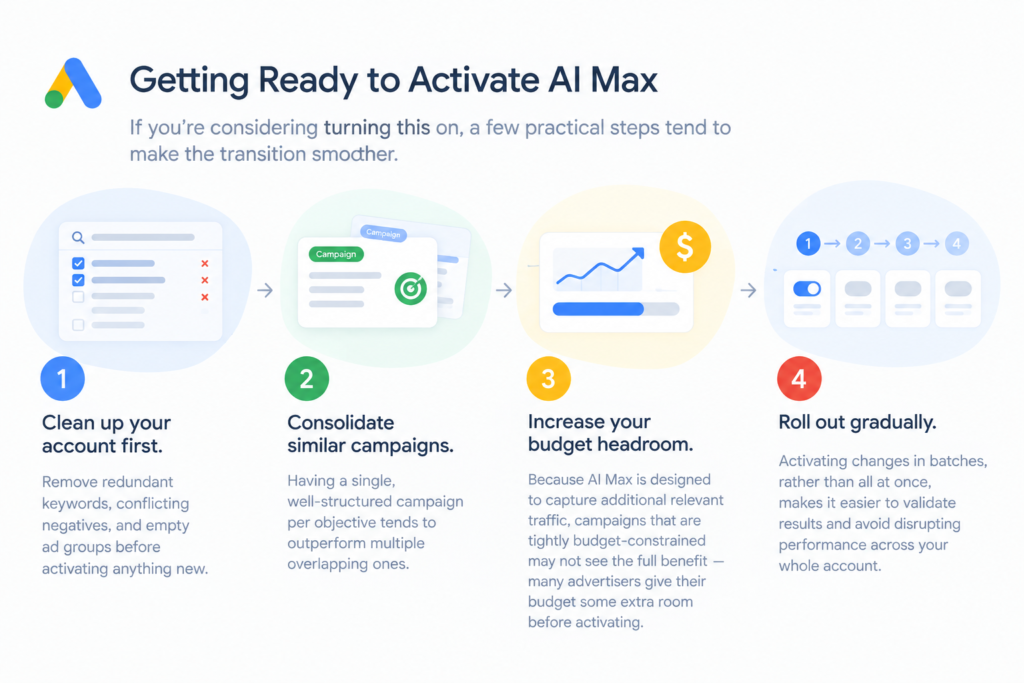
Getting Ready to Activate AI Max
Is It Worth It?
Like most automation shifts in advertising, the value depends on execution. Accounts with clean data, clear ad group theming, and sufficient budget tend to see the strongest gains, while messy, poorly segmented accounts may see more mixed results until the underlying structure is fixed.
The broader trend, though, is clear: search behavior is moving toward more natural, AI-assisted queries, and campaign structures that can flexibly match that behavior — without losing brand safety — are likely to become the standard rather than the exception.
Resources
«About AI Max for Search campaigns» – Google Ads Help
https://support.google.com/google-ads/answer/15910366?hl=en